Executive Summary
A representative contract development and manufacturing organization (CDMO) — the kind serving multiple pharmaceutical clients from one North American site — produces oral solid dose products across dispensing, granulation, fluid-bed drying, compression and coating. Powder is the product, and some of it escapes at every step: lactose, starch and cellulose blends settled on press frames, room fixtures and mezzanines between changeovers.
The facility carried a constraint most industries never face: the same dust was simultaneously a combustible-dust problem (lactose and common excipients are combustible), an exposure problem (blends carry active ingredient at potencies governed by occupational exposure limits), and a quality problem (carryover between products is a GMP event). Its Dust Hazard Analysis and an internal GMP review each flagged the housekeeping method — unrated vacuums and undocumented manual wipe-downs.
The engineered response treated all three constraints as one specification: explosion-proof HEPA vacuums for suite-level recovery, a central vacuum serving the compression rooms through fixed inlet drops with the power unit located outside the clean space, grounded stainless tools and static-dissipative hoses throughout, and a written, repeatable cleaning method that slots directly into the site's cleaning-validation program.
Project Overview
- Facility type
- Pharmaceutical CDMO — oral solid dose
- Processes
- Dispensing, granulation, fluid-bed drying, compression, coating, packaging
- Environment
- Classified production suites; graded clean areas
- Dust generation points
- Weigh booths, granulator and dryer unloading, tablet presses, coating pans
- Housekeeping challenge
- Combustibility, exposure limits and cross-contamination in the same material
- Potential ignition sources
- Unrated vacuum motors, static from insulating hoses, electrical equipment in powder areas
Industry Background
Oral solid dose manufacturing is powder handling from end to end. Raw excipients arrive in bulk, are dispensed, blended, granulated, dried, compressed and coated — and each transfer liberates fines. Lactose, the most common tablet filler, is a combustible organic dust; so are starches, sugars and microcrystalline cellulose. The industry's own materials sit on the standard combustible-dust lists.
What makes pharmaceutical dust unusual is the second constraint layered on top. Blends carry active pharmaceutical ingredient, and potent compounds are governed by occupational exposure limits that can sit orders of magnitude below nuisance-dust levels — the banding frameworks pharmaceutical EHS teams work in daily. A recovery method that controls the explosion hazard but exhausts fines back into the room fails the exposure requirement; one that contains exposure but adds ignition sources fails the DHA.
The third constraint is regulatory in a different direction: GMP. Cleaning between products must be defined, repeatable and demonstrable, because carryover is a quality defect with patient-facing consequences. That turns housekeeping equipment into validation-relevant equipment — variable manual technique is precisely what cleaning validation exists to eliminate.
The Challenge
- Safety
- Lactose and excipient blends are combustible organic dusts; accumulation in compression suites created fuel for the secondary-explosion mechanism the standards target.
- Operations
- Changeover cleaning sat on the critical path between products; slow, manual methods stretched every campaign transition.
- Compliance
- The DHA flagged unrated equipment; the GMP review flagged undocumented methods — two audit exposures from one practice.
- Maintenance
- Fine powder migrated into press mechanisms and room HVAC, driving unplanned service.
- Employee exposure
- Blend dust carries API; recovery had to hold captured fines to exposure-banding expectations, not just fire-safety ones.
- Production interruptions
- A failed cleaning verification means investigation and re-cleaning — housekeeping quality directly gated release.
Hazard Analysis
The explosion pentagon assembles quietly in a tablet plant. Fuel: fine lactose and blend dust, generated at every transfer. Oxygen: ambient. Dispersion: energetic cleaning, compressed-air use, or the ordinary turbulence of unloading a dryer. Confinement: process rooms, ducting and equipment enclosures. Ignition: unrated electrical equipment and static discharge — the two sources an engineered recovery path exists to remove.
Organic dusts like lactose typically sit in the lower explosion-severity classes than fine metals, but severity class is not a safe-harbor: documented catastrophic events in sugar and other food-adjacent powders are exactly why OSHA reissued its Combustible Dust National Emphasis Program in 2008 and why NFPA 652 made the Dust Hazard Analysis a baseline obligation, now carried into the consolidated NFPA 660.
The secondary-explosion mechanism is the housekeeping driver here as everywhere: settled layers on presses, ledges and mezzanines become airborne fuel when disturbed. Published guidance treats accumulations as thin as 1/32 of an inch over a modest fraction of a room as a credible hazard — a threshold a compression suite can reach within a campaign.
Static electricity deserves specific attention because pharmaceutical powders are moved through hoses constantly. Fine powder in an insulating plastic hose is a charge generator; the control is a continuous conductive path — hose, wand, canister, chassis — verified to ground, so charge never stores where dust concentration peaks.
| Pentagon element | Present as |
|---|---|
| Fuel | Lactose, starch and cellulose blend dust from dispensing through compression |
| Oxygen | Ambient suite atmosphere |
| Dispersion | Powder transfers, dryer unloading, energetic cleaning methods |
| Confinement | Process suites, equipment enclosures, ducting |
| Ignition | Unrated vacuum motors, static discharge from insulating hoses |
Site Assessment Findings
- Visible blend-dust accumulation on press frames, feed frames and room ledges within single campaigns
- Consumer-grade vacuums — sparking motors, plastic hoses, no grounding path — in daily suite use
- Cleaning methods varying by operator and shift; no written method tied to the validation program
- Captured dust exhausted through non-HEPA filtration, returning fines to room air
- Collected material handled dry and open during disposal transfers
- No fixed recovery provision in the compression rooms with the highest cleaning frequency
Recommended Solution
The specification unified the three constraints. For suite-level recovery, explosion-proof HEPA vacuums in stainless construction: ignition sources engineered out for the DHA, a tested 99.99% final stage holding captured fines for the exposure requirement, and wash-down-friendly surfaces for the GMP one.
For the compression rooms — the highest-frequency cleaning point — a central vacuum system with fixed inlet drops at each press, its power unit and primary separation located outside the clean space. Operators clean at the drop with grounded stainless tools; noise, heat and exhaust stay out of the suite; collected material consolidates at one controlled discharge.
Around the equipment, a written cleaning method: defined sequence, defined tools, defined frequencies per room grade, and sealed handling of collected material. Because the method is fixed and repeatable, it slots into cleaning validation instead of fighting it.
Equipment Used
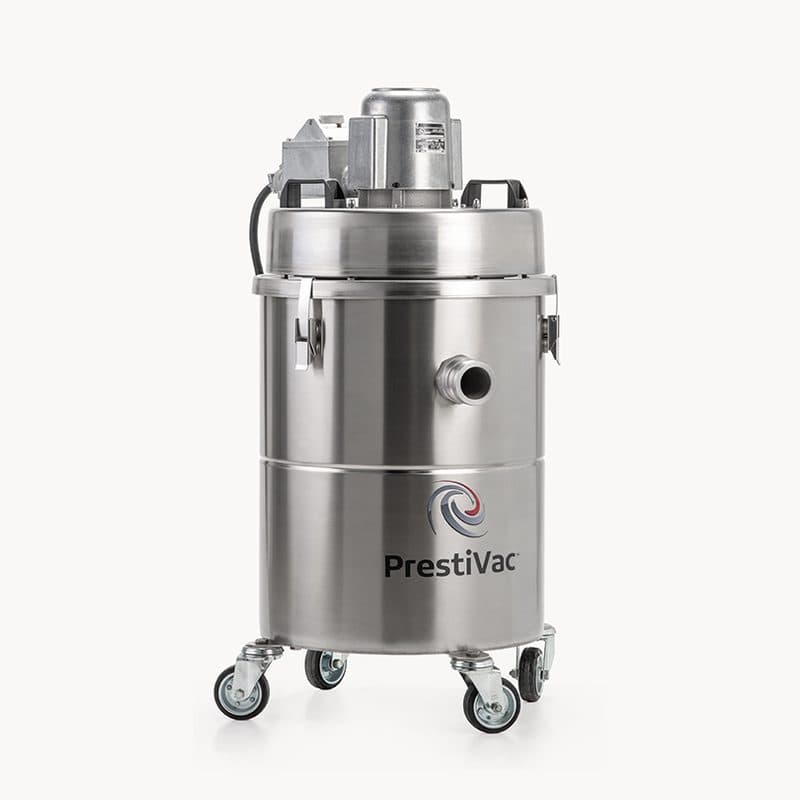
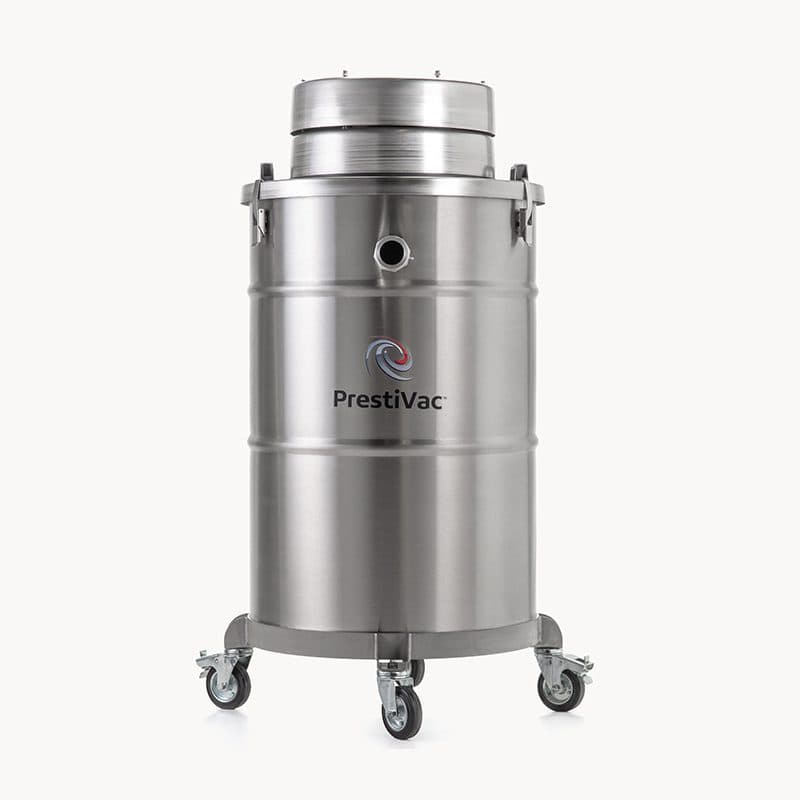
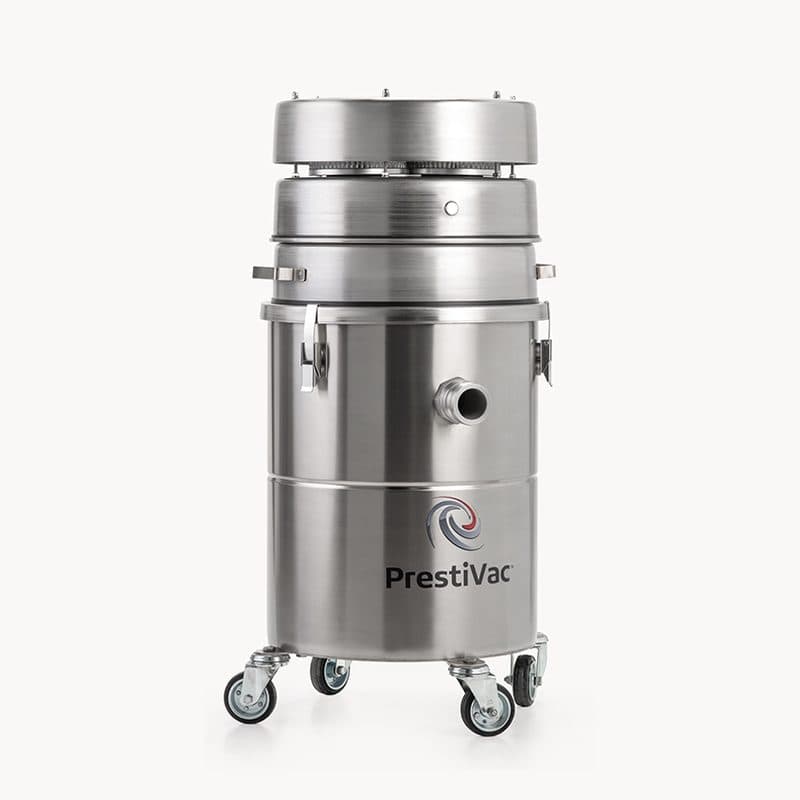
Explosion-proof HEPA vacuums, stainless construction (EVX series, e.g. EVX-15 EX)
Suite-level recovery meeting combustibility and exposure requirements together
Central vacuum system with fixed inlet drops
Compression-room cleaning with the power unit outside the clean space
Static-dissipative hose assemblies
Continuous conductive path from pickup point to canister
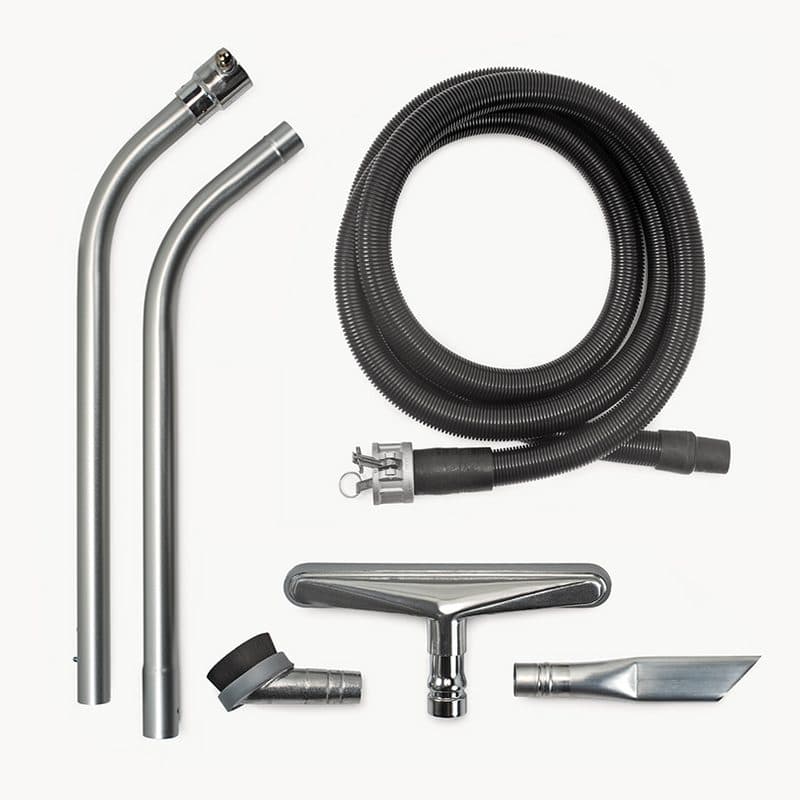
Grounded stainless wands, floor and crevice tools
Non-sparking, wash-down-friendly contact at the pickup point
Tested HEPA final-stage filtration (99.99% at 0.3 µm)
Captured fines stay captured — the exposure control
Bonding and grounding kits with verification points
Charge control checked at commissioning and on PM
Sealed stainless collection containers
Contained transfer of collected blend dust to disposal
Installation & Implementation
- 1
Assessment
Walk-down of dust generation points by room grade; method audit against the DHA and the cleaning-validation master plan.
- 2
Planning
Room-by-room equipment assignment; inlet-drop placement at each press; material-handling route to controlled disposal.
- 3
Training
Operator sessions on the written method: sequence, grounding checks, filter handling and sealed disposal.
- 4
Commissioning
Grounding continuity per station; suction verification at each drop; filtration integrity confirmation.
- 5
Operator education
Method cards at point of use; one page per room grade.
- 6
Maintenance program
Condition-based filter service and periodic grounding re-verification folded into the PM system.
Before vs After
| Aspect | Before | After |
|---|---|---|
| Cleaning method | Operator-dependent manual technique | Written, repeatable vacuum method tied to validation |
| Recovery equipment | Unrated consumer vacuums | Explosion-proof stainless HEPA units + central drops |
| Ignition sources in recovery path | Sparking motors, static-generating hoses | Engineered out; bonded conductive path throughout |
| Captured fines | Partially exhausted back to room air | Retained at HEPA 99.99% |
| Compression-room cleaning | Portable equipment wheeled between suites | Fixed inlet drops; power unit outside the clean space |
| Collected material | Dry, open handling | Sealed containers to controlled disposal |
Compliance Improvements
The engineered program supports compliance with the fundamentals NFPA 652 established and NFPA 660 now carries: a DHA-informed housekeeping program, appropriate recovery equipment, and elimination of practices that suspend dust clouds. It supports the housekeeping expectations enforced under OSHA's Combustible Dust National Emphasis Program.
On the quality side, a fixed method with defined tools and frequencies supports GMP cleaning-validation expectations — the equipment doesn't validate anything by itself, but it makes the method capable of validation, which variable manual technique never was.
For sites operating under European frameworks, the same architecture aligns with ATEX zone principles for dust. Component certifications and listings vary by model and configuration; documentation is supplied per application, and the program is described throughout as supporting compliance rather than conferring it.
Operational Improvements
- Changeover cleaning became a defined-duration task instead of an open-ended one — a fixed method with fixed tools is schedulable, and compression-room drops remove equipment staging entirely.
- Cleaning verification became more predictable by mechanism: single-pass capture at the source with HEPA-retained exhaust stops redistributing fines onto surfaces already cleaned.
- Operator exposure during cleaning drops by design — capture at the nozzle, no re-entrained exhaust, sealed disposal. (Improvements are stated by mechanism; this representative scenario publishes no fabricated percentages.)
- Maintenance load on presses and room HVAC eases as ambient fines decline — dust that is captured at the source never migrates into mechanisms.
Technical Explanation
Why HEPA is the exposure control, not a luxury: with potent blends, the question is never whether the vacuum picks material up — it's where the exhaust air goes. A tested 99.99% at 0.3 µm final stage means the recovery airflow returns cleaner than the room it came from, which is the whole requirement in one number.
Why the central system's power unit sits outside the clean space: everything a vacuum power unit produces — heat, noise, exhaust, service access — is something a graded room is designed to exclude. Fixed drops put only the pickup point in the suite; the machinery lives where machinery belongs.
Why stainless, wash-down construction matters here specifically: in a GMP plant the vacuum is itself a piece of product-contact-adjacent equipment that must be cleanable between campaigns. Painted mild steel and fabric surfaces are where carryover hides.
Why the grounding path is continuous and verified: fine organic powders generate charge in motion exactly like metal fines do. A conductive hose bonded through wand, canister and chassis — checked at commissioning and on a PM cycle — keeps charge at ground potential instead of storing it for a discharge inside the collection vessel.
Frequently Asked Questions
Is lactose really a combustible dust?
Yes. Lactose, starches, sugars and microcrystalline cellulose — the standard tablet excipients — are combustible organic dusts. Severity varies with particle size and must be confirmed by testing, but the materials themselves sit on the standard combustible-dust lists.
Do pharmaceutical plants really have explosion risk?
Anywhere fine organic powder is handled in quantity, the hazard exists — that is why NFPA 652/660's Dust Hazard Analysis obligation applies. Pharmaceutical facilities add exposure and cross-contamination constraints on top, but they do not subtract the combustibility one.
What does an OEB or exposure band mean for vacuum selection?
Potency banding sets how strictly airborne exposure must be controlled. For recovery equipment, the practical consequences are HEPA-retained exhaust, sealed collection and disposal, and capture at the source — the more potent the compound, the less acceptable any re-entrainment becomes.
Why put the central vacuum's power unit outside the suite?
It removes heat, noise, motor exhaust and service traffic from the graded space, leaving only a fixed inlet drop and a grounded tool inside. The compression room gets the cleaning capability without hosting the machinery.
Can the same vacuum serve multiple products?
Only within what your cleaning-validation program supports. Stainless, wash-down construction and defined cleaning methods for the vacuum itself are what make shared equipment defensible; dedicated units are the conservative answer for the most potent compounds.
Is HEPA filtration required by regulation?
Not by a single universal rule — it is driven by the exposure limits of what you handle and by keeping combustible fines from re-entering room air. In oral solid dose practice, HEPA-retained exhaust is effectively the baseline.
What is the 1/32 inch guidance?
Published OSHA and NFPA guidance treats a dust layer as thin as 1/32 of an inch, over a modest fraction of a room's surface, as a credible secondary-explosion hazard. It is a housekeeping trigger, not a safety allowance.
How is collected pharmaceutical dust disposed of?
Sealed, per the site's waste procedures — the container transfer is part of the written method, because open dry handling would undo both the exposure and the housekeeping controls at the last step.
Key Takeaways
- Pharmaceutical dust carries three constraints at once — combustibility, exposure and cross-contamination — and the recovery architecture must satisfy all three in the same pass.
- Lactose and standard excipients are combustible organic dusts; the DHA obligation applies to tablet plants like any other powder handler.
- HEPA-retained exhaust is the exposure control: capture means nothing if the airflow re-emits fines.
- Fixed inlet drops with a remote power unit give graded rooms cleaning capability without hosting machinery.
- A written, repeatable vacuum method is what makes housekeeping validation-capable — equipment alone is not a method.
- Grounding is verified, not assumed: fine organic powders generate static exactly like metal fines do.
Classification
- Industry
- Pharmaceutical
- Application
- Tablet Production
- Hazard
- Combustible Organic Dust & Potent Compound Exposure
- Material
- Lactose
- Process
- Compression & Granulation
- Dust Class
- Combustible Organic Dust
- Facility Type
- Pharmaceutical CDMO Tablet Plant
- Relevant Standards
- NFPA 660, NFPA 652, OSHA NEP, GMP (context), ATEX principles (where applicable)
- Products Featured
- EVX Series explosion-proof HEPA vacuums, Central vacuum systems, Static-dissipative hose & tool kits, Sealed collection containers
- Target Personas
- Plant Manager, EHS Manager, Quality / Validation Manager, Maintenance Manager